


TL;DR:
- The label “natural” varies widely and does not guarantee gentleness or safety for skin.
- High pH in natural soaps can disrupt the skin’s acid mantle, causing dryness and irritation.
- Choosing pH-balanced, scientifically formulated cleansers aligns skin health with ethical values.
Most people assume that slapping the word “natural” on a face soap makes it automatically safer, gentler, and better for your skin. It feels logical. Plants are gentle. Chemicals sound scary. But the reality is more nuanced, and for anyone serious about their skin health and their values, that assumption deserves a closer look. The pH of your skin, the actual ingredients in the formula, and whether a product carries verified cruelty-free or vegan certifications all matter far more than a single label. This guide walks you through the science, the ethics, and the practical steps to make a genuinely informed choice.
Table of Contents
- What does ‘natural’ in face soap actually mean?
- How natural face soaps affect your skin: pH, cleansing, and potential pitfalls
- Natural vs. synthetic: Ethics, performance, and what really matters
- How to choose a natural face soap that aligns with your skin and ethics
- Our take: The uncomfortable truth about ‘natural’ face soaps
- Discover effective, skin-friendly skincare at Didis Beauty Center
- Frequently asked questions
Key Takeaways
| Point | Details |
|---|---|
| Natural is not always gentler | Natural soaps can be harsh if their pH is too alkaline for your skin. |
| Check for pH balance | Choosing a face cleanser with a pH of 4.5-5.5 protects your skin barrier. |
| Ethics and evidence both matter | Look for vegan or cruelty-free products but always consider ingredient quality and performance. |
| Personalize to your needs | Adapt your cleanser choice to your own sensitivities, skin conditions, and values. |
What does ‘natural’ in face soap actually mean?
The word “natural” gets used freely in beauty marketing, but there is no universal legal definition for it. A soap can call itself natural if it contains even a small percentage of plant-based ingredients, regardless of what else is in the formula. That lack of regulation creates a wide spectrum of products that all wear the same label.
A truly natural face soap is typically made with plant-based oils like coconut, olive, or shea, combined with botanicals such as lavender, chamomile, or green tea extract. The manufacturing process involves minimal chemical processing, and the finished product avoids synthetic fragrances, parabens, and petroleum-derived ingredients. That is the ideal. In practice, many products marketed as natural fall short of this standard.
It also helps to understand the difference between three terms that often get used interchangeably:
- Natural: Made primarily from plant or mineral-derived ingredients with minimal processing
- Vegan: Contains no animal-derived ingredients, including beeswax, lanolin, or honey
- Cruelty-free: Not tested on animals at any stage of production or ingredient sourcing
A soap can be natural but not vegan (if it contains honey or goat’s milk). It can be vegan but not cruelty-free (if the brand tests on animals in certain markets). And it can claim to be natural while still containing synthetic preservatives. These distinctions matter deeply for eco-conscious consumers.
Why do so many people gravitate toward vegan skincare and eco-conscious beauty? The motivations are real and valid. Natural and vegan soaps appeal for sustainability, cruelty-free ethics, and nutrient-rich ingredients that synthetic alternatives often lack. For anyone who cares about what goes on their skin and what impact their purchase has on the planet, these factors carry genuine weight.
But caring about ethics does not mean you should skip the science. Ingredient quality varies enormously between brands, and understanding what is actually in your soap is the first step to making a choice that serves both your skin and your values. Exploring cruelty-free skincare examples is a great way to start building that knowledge.
How natural face soaps affect your skin: pH, cleansing, and potential pitfalls
Understanding ingredients is only half the story. It is crucial to see how natural soaps actually interact with your skin, and the key factor here is pH.
Your skin’s surface maintains a mildly acidic environment, typically between pH 4.5 and 5.5. This is called the acid mantle, and it acts as a protective barrier against bacteria, environmental pollutants, and moisture loss. When you use a cleanser that disrupts this balance, your skin has to work hard to recover.
Here is the problem: traditional natural soaps have a high alkaline pH of 8 to 10 or higher, which can disrupt the skin’s acid mantle and cause dryness or irritation. This is not a minor issue. A disrupted acid mantle can take several days to fully recover, and during that window, your skin is more vulnerable to breakouts, sensitivity, and transepidermal water loss.

Research backs this up. In a study comparing marketed soaps, 53 of 64 tested soaps had a pH between 9 and 10, with herbal soaps showing better foam retention but weaker antibacterial properties than their synthetic counterparts.
| Soap type | Typical pH range | Acid mantle impact | Best for |
|---|---|---|---|
| Traditional natural soap | 9 to 10+ | High disruption risk | Body cleansing |
| Herbal/botanical soap | 8 to 9.5 | Moderate disruption | Normal to oily skin |
| Syndet (synthetic detergent) | 5.5 to 7 | Low disruption risk | Sensitive or dry skin |
| pH-balanced natural formula | 5.5 to 6.5 | Minimal disruption | All skin types |
“Your skin’s acid mantle is its first line of defense. Using an alkaline soap regularly is like washing away your own armor.” This is why dermatologists consistently recommend understanding your cleanser’s pH before committing to it.
The good news is that not all natural soaps are created equal. Some modern formulations specifically address pH by incorporating acidic ingredients or using cold-process methods that result in a gentler final product. Learning about pH-balanced skincare benefits can help you identify these smarter options.
For people with eczema, rosacea, or chronic sensitivity, the acid mantle disruptor effect is especially significant. Even beloved natural options like castile soap can be problematic if used on the face regularly. The science of face soap cleansing offers a deeper look at how different formulas behave on skin.
Pro Tip: If you want to test your current soap’s pH at home, use inexpensive pH strips. A reading above 7 on your face cleanser is a signal worth paying attention to.
Natural vs. synthetic: Ethics, performance, and what really matters
Once you understand how soaps work on your skin, the choice between natural and synthetic also comes down to values and real-world results.
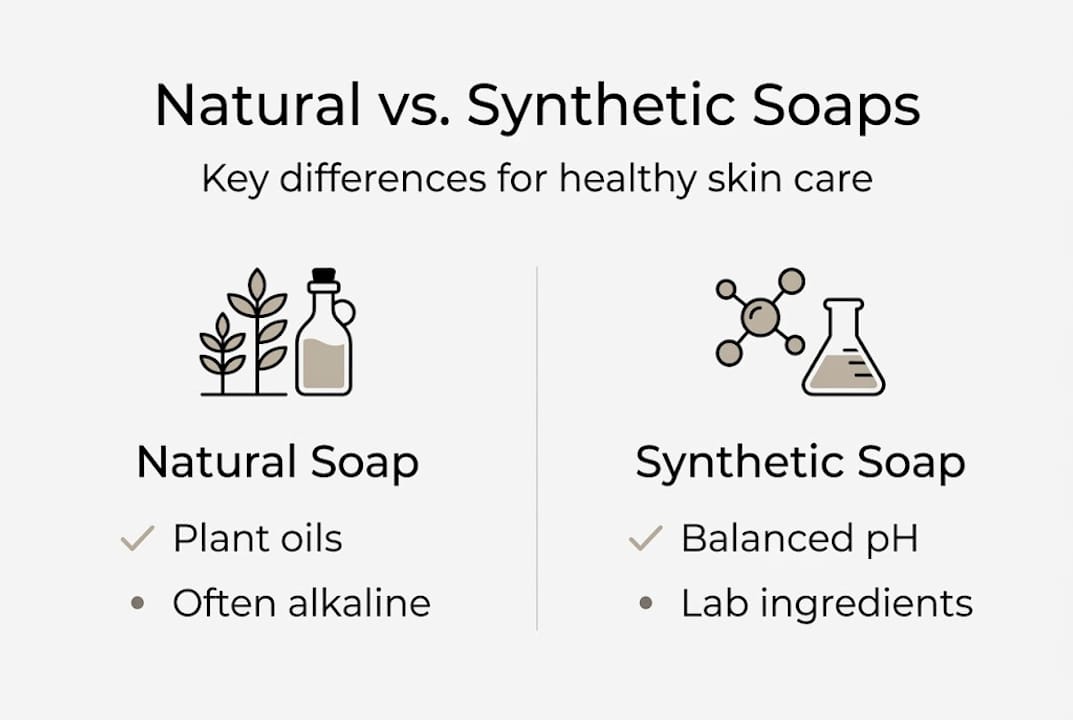
Synthetic cleansers, often called syndets (short for synthetic detergent bars), are formulated to mimic the skin’s natural pH. Dermatologists frequently recommend them for facial cleansing, particularly for people with sensitive, acne-prone, or dry skin. They tend to be more stable, consistent in performance, and less likely to cause irritation than traditional soap bars.
However, synthetics can outperform naturals in stability and antimicrobial efficacy, and the “clean beauty” category is largely unregulated, meaning a product can claim to be clean without meeting any defined standard. That is a critical point. Marketing language is not the same as verified performance.
| Factor | Natural face soap | Synthetic cleanser |
|---|---|---|
| pH compatibility | Often alkaline (8 to 10+) | Usually balanced (5.5 to 7) |
| Ingredient transparency | Generally higher | Varies by brand |
| Environmental impact | Often lower | Depends on formulation |
| Cruelty-free options | Widely available | Available but less common |
| Dermatologist preference (sensitive skin) | Less common | More common |
| Vegan formulations | Widely available | Available |
So where does that leave you as a consumer who cares about both skin health and ethics? The answer is not to abandon natural soaps entirely. It is to apply the same critical thinking to natural products that you would to any other purchase.
Here is what to keep in mind:
- A natural soap with a pH of 9.5 and synthetic fragrance is not doing your skin any favors
- A syndet bar that is vegan, cruelty-free, and pH-balanced can align with your ethics and your skin’s needs
- Research into soap alkalinity and skin barrier function shows that barrier disruption is a real, measurable outcome of high-pH cleansing
- Eco-friendly skincare principles go beyond ingredients to include packaging, sourcing, and brand transparency
The best choice is one that respects your skin’s biology and your personal values at the same time. Those two goals are not mutually exclusive.
How to choose a natural face soap that aligns with your skin and ethics
With the science and ethical factors in mind, here is how you can select the best natural face soap for your routine.
The process does not have to be overwhelming. A few focused questions can cut through the noise quickly.
- Check the pH. Look for soaps labeled as pH-balanced, or contact the brand directly. A facial cleanser should ideally fall between 4.5 and 6.5. If the brand cannot tell you the pH, that is a red flag.
- Look for superfatted formulas. Superfatted soaps contain extra oils that remain in the bar after saponification, leaving a moisturizing residue on skin rather than stripping it. This helps offset alkalinity and reduces the drying effect.
- Verify third-party certifications. Labels like Leaping Bunny (cruelty-free) or certified vegan logos from recognized organizations carry more weight than self-declared claims. These require audits and ongoing compliance.
- Match the formula to your skin type. For eczema or sensitive skin, fragrance-free natural soaps with soothing agents like oatmeal or chamomile are recommended by experts, but pH balance remains the most important factor.
- Read the full ingredient list. Ingredients are listed in descending order of concentration. If water and a plant oil are the first two ingredients, that is a good sign. If synthetic fragrance or alcohol appears near the top, reconsider.
Understanding soap pH is genuinely useful knowledge for any skincare shopper. It takes the guesswork out of evaluating products and helps you see past marketing language.
For deeper guidance on building a routine that works, the best choices in face soaps and the science and benefits of pH balance are worth bookmarking.
Pro Tip: When switching to a new face soap, give your skin a full two-week adjustment period before judging the results. Skin takes time to recalibrate, especially after a significant pH shift.
Our take: The uncomfortable truth about ‘natural’ face soaps
Here is our honest perspective, and it might surprise you coming from a brand that genuinely loves natural and vegan skincare.
Not every skin type benefits from traditional natural soaps. For some people, especially those with sensitive, dry, or eczema-prone skin, switching to a “natural” bar soap can actually make things worse. The alkalinity strips the very oils that protect your skin, and the damage can take days to repair. We have seen this happen, and it is frustrating when someone switches to a “cleaner” product and ends up with more irritation than before.
The “clean beauty” space is largely unregulated, and expert consensus consistently values evidence and pH balance over labels. That does not mean natural soaps are bad. It means the label alone is not enough information.
Our real position: vegan and cruelty-free ethics matter enormously, and we stand behind them fully. But those values should be paired with genuine ingredient transparency and formulation science. The best natural face soap is one that respects your skin’s biology as much as it respects the planet. Exploring pH-focused skincare insights is one of the most practical things you can do to bridge that gap between values and results.
Discover effective, skin-friendly skincare at Didis Beauty Center
Ready to take the next step? At Didis Beauty Center, we curate skincare that takes both your ethics and your skin’s needs seriously. Our selections go beyond surface-level marketing to offer formulas that are genuinely thoughtful.
If you are building a daily routine, the Daily Essential Bundle is a great starting point, pairing cleansing with targeted care. For nighttime recovery, the Detox Nightwear Face Cream supports your skin’s natural repair cycle while you sleep. Every product we feature is chosen with ingredient transparency and skin compatibility in mind, so you can shop with confidence.
Frequently asked questions
Are natural face soaps better than synthetic cleansers for sensitive skin?
Not always. Dermatologists prefer syndets, which are pH-balanced cleansers, over true soaps for facial use, especially for sensitive skin, because most natural soaps are alkaline and can cause irritation.
What ingredients should I look for in a gentle natural face soap?
Look for pH-balanced, fragrance-free formulas with soothing botanicals. Cucumber extract and botanicals provide hydration and antioxidants, and experts recommend oatmeal or chamomile for sensitive skin types.
Is a vegan or cruelty-free soap always better for my skin?
No. Vegan and cruelty-free labels reflect ethical sourcing practices, but product performance and pH compatibility matter most when it comes to how a soap actually behaves on your skin.
Can alkaline natural soaps damage my skin barrier?
Yes. Traditional natural soaps with an alkaline pH of 8 to 10 or higher can disrupt your skin’s acid mantle, leading to dryness and irritation that often requires several days to fully recover from.
Discourse (0)