


Finding reliable vegan skincare suppliers can feel overwhelming with so many options across American and global markets. Over 60 percent of new eco-friendly beauty brands struggle to meet both quality and affordability standards in their first year. If you are focused on launching a sustainable skincare line, knowing exactly what to look for can help you avoid costly mistakes and choose the partners who will support your brand’s growth.
Table of Contents
- Step 1: Define Your Skincare Supplier Requirements
- Step 2: Research Trusted Vegan Wholesale Sources
- Step 3: Evaluate Supplier Offerings And Credentials
- Step 4: Request Samples And Verify Product Quality
- Step 5: Negotiate Pricing And Minimums For Affordability
- Step 6: Establish A Reliable Partnership Agreement
Quick Summary
| Key Takeaway | Explanation |
|---|---|
| 1. Define Clear Supplier Requirements | Clearly outline your product specifications, including ethical and quality standards, to guide supplier selection effectively. |
| 2. Research Vegan Wholesale Sources | Identify reputable suppliers with strong vegan credentials to ensure sustainable product development aligned with your brand values. |
| 3. Systematically Evaluate Suppliers | Use a structured approach to assess suppliers’ quality certifications, capabilities, and compliance to ensure they meet your brand’s needs. |
| 4. Test Samples for Quality Verification | Request and evaluate product samples to validate quality, consistency, and regulatory compliance before finalizing supplier contracts. |
| 5. Negotiate Pricing and Terms Wisely | Strategically discuss pricing, minimum order quantities, and payment options to establish a financially stable partnership with suppliers. |
Step 1: Define your skincare supplier requirements
Successful skincare brand creation starts with crystal clear supplier requirements that align perfectly with your product vision and market needs. Defining these requirements is a strategic process that will determine the quality and trajectory of your entire product line.
Begin by mapping out your precise product specifications, focusing on critical elements that matter most to your brand. Supplier selection involves understanding complex product requirements that go well beyond basic ingredient sourcing. Consider factors like product consistency, raw material quality, manufacturing standards, regulatory compliance, and ethical production practices. Your requirements should cover technical specifications such as ingredient purity, production capacity, minimum order quantities, quality control processes, and certification standards like ISO or Good Manufacturing Practice (GMP).
Next, create a comprehensive checklist that includes non negotiable criteria for potential suppliers. This might include requirements like vegan certification, cruelty free production, sustainable packaging options, and transparency in supply chain practices. Research potential suppliers thoroughly, request detailed documentation, and compare their capabilities against your specific brand standards.
Pro tip: Create a weighted scoring system to objectively evaluate potential skincare suppliers, assigning numerical values to each critical requirement to make your selection process more systematic and data driven.
Here’s a summary of how supplier requirements influence skincare brand success:
| Requirement Category | Business Impact | Example Criteria |
|---|---|---|
| Ingredient Quality | Ensures product safety | Purity, certification ratings |
| Ethical Production | Builds consumer trust | Vegan, cruelty-free standards |
| Manufacturing Standards | Guarantees product consistency | GMP, ISO certifications |
| Supply Chain Transparency | Reduces operational risks | Traceability, clear sourcing |
Step 2: Research trusted vegan wholesale sources
Unlocking the right vegan wholesale sources is crucial for building a sustainable and ethical skincare brand. This step will help you identify and connect with suppliers who share your commitment to cruelty-free and plant-based product development.

The global vegan beauty product market is rapidly expanding, driven by increasing consumer demand for ethical and sustainable products. Start your research by identifying suppliers who specialize in vegan skincare manufacturing and hold recognized certifications. Look for manufacturers that provide comprehensive documentation of their vegan credentials, including certifications from organizations like Vegan Action, The Vegan Society, or PETA. Examine their ingredient sourcing practices, production methods, and commitment to ethical manufacturing.
Develop a systematic approach to evaluating potential suppliers by creating a detailed assessment framework. Natural and vegan cosmetics wholesale suppliers prioritize ethically sourced ingredients and international quality standards, so focus on suppliers who can demonstrate transparency in their supply chain. Request detailed product specifications, sample formulations, and comprehensive documentation about their manufacturing processes. Pay close attention to their ability to meet your specific requirements, including minimum order quantities, production capabilities, and quality control standards.
Pro tip: Create a comprehensive supplier evaluation spreadsheet that includes key criteria such as certification status, minimum order requirements, pricing, sample availability, and sustainability practices to streamline your selection process.
Step 3: Evaluate supplier offerings and credentials
Carefully assessing potential skincare suppliers is a critical step in building a reliable and high-quality product line. Your goal is to thoroughly examine each supplier’s capabilities, credentials, and capacity to meet your brand’s specific requirements.
Key criteria for evaluating skincare suppliers involve comprehensive analysis of international manufacturing standards, focusing on multiple critical dimensions. Begin by examining their compliance with internationally recognized quality certifications such as ISO 22716 for cosmetic manufacturing and ISO 9001 for quality management systems. Investigate their production flexibility, regulatory approvals for your target markets, and their ability to handle your specific product requirements. Pay close attention to their quality control processes, ingredient sourcing transparency, and ability to provide detailed documentation about their manufacturing methods.
Develop a systematic evaluation process that goes beyond surface level assessments. Request comprehensive documentation including detailed product specifications, manufacturing protocols, ingredient lists, and safety testing results. Conduct thorough background checks by requesting references from other brands they have worked with, reviewing their production capabilities, and understanding their supply chain resilience. Examine their capacity for crisis management, after sales support, and their ability to scale production as your brand grows. Look for suppliers who demonstrate not just technical competence but also a commitment to innovation and continuous improvement in their manufacturing processes.
Pro tip: Create a multi tier scoring system that weights different supplier credentials objectively, allowing you to make data driven decisions that go beyond subjective impressions.
Compare key supplier credentials for effective evaluation:
| Credential Type | Why It Matters | Evaluation Method |
|---|---|---|
| International Certification | Confirms quality standards | Review ISO, GMP documents |
| Production Flexibility | Allows for scalability | Assess custom order capacity |
| Regulatory Compliance | Ensures legal market entry | Check approvals in target area |
| Quality Control Processes | Protects brand reputation | Request safety testing reports |
Step 4: Request samples and verify product quality
Testing product samples is a critical step in validating potential skincare suppliers and ensuring your brand meets the highest quality standards. This phase will help you make informed decisions about your manufacturing partnership.
Comprehensive testing of skincare samples by accredited laboratories ensures product safety, microbiological stability, and regulatory compliance, making it an essential part of your supplier evaluation process. Request multiple product samples that represent the full range of formulations you intend to produce. Examine each sample meticulously for consistency, texture, fragrance, color, and overall sensory experience. Pay close attention to packaging, labeling, and the suppliers ability to meet your specific product specifications. Conduct thorough visual inspections and perform preliminary stability tests to assess how the products respond to different environmental conditions.
Go beyond initial visual assessments by engaging independent third party laboratories for comprehensive product testing. Request detailed testing reports that cover critical areas such as microbiological stability, preservative efficacy, allergen detection, and performance claims substantiation. Analyze the technical documentation provided with samples, looking for evidence of rigorous quality control processes. Compare the sample products against your original specifications, checking for precise ingredient concentrations, pH levels, and overall formulation integrity. Consider sending samples to multiple independent laboratories to cross verify results and ensure comprehensive quality validation.
Pro tip: Request samples in various batch sizes and store them under different environmental conditions to simulate real world storage scenarios and assess long term product stability.
Step 5: Negotiate pricing and minimums for affordability
Navigating pricing negotiations is a crucial step in establishing a financially sustainable relationship with your wholesale skincare suppliers. Your goal is to secure competitive pricing without compromising product quality or your brand’s long term potential.
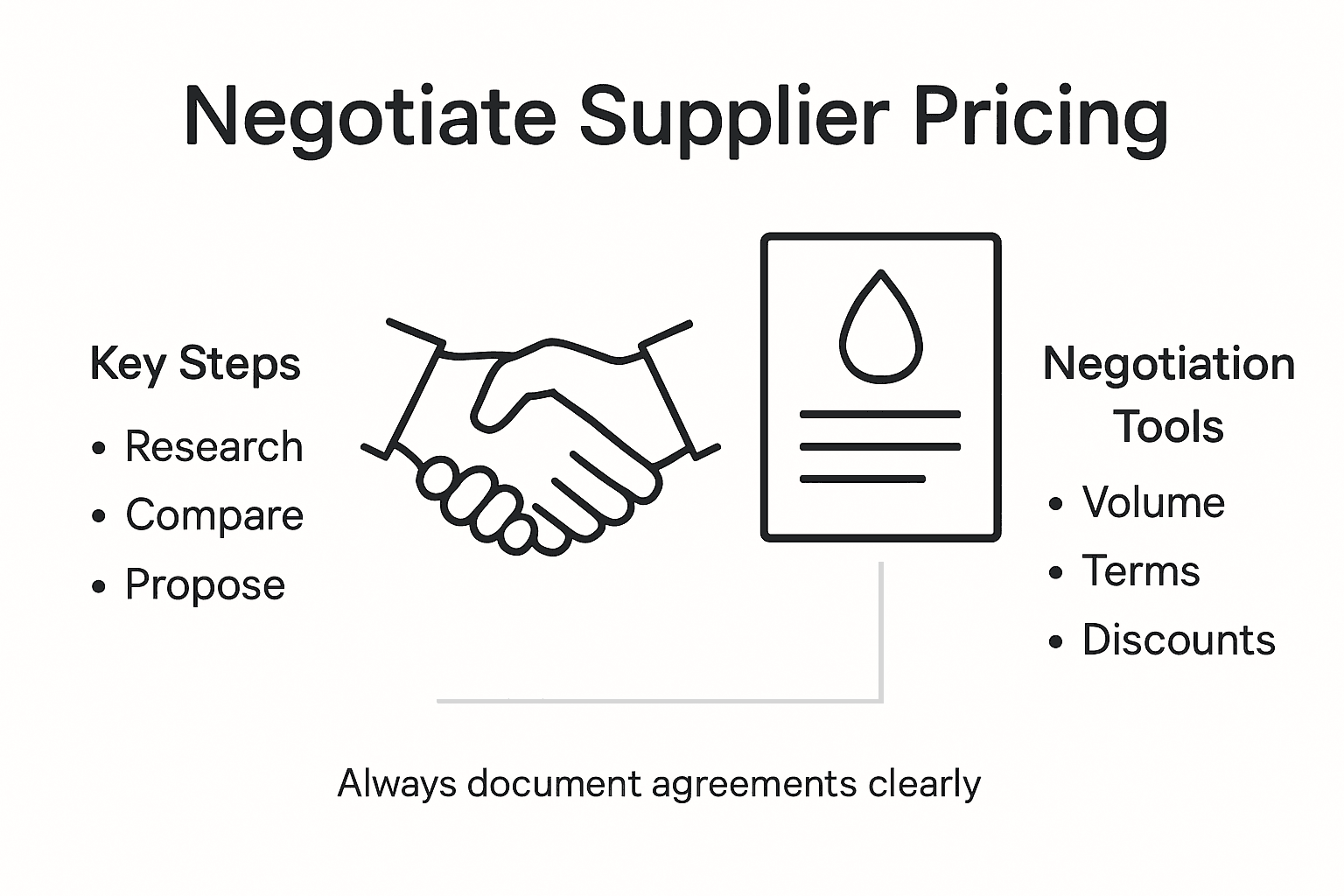
Negotiating minimum order quantities requires strategic understanding of supplier cost structures and production processes, which directly impacts your financial flexibility. Begin by thoroughly researching market rates and gathering comprehensive data about standard pricing in your specific skincare product category. Approach negotiations with a clear understanding of your budget constraints and production needs. Prepare a compelling case that demonstrates your brands potential for growth and long term partnership. Show suppliers that you are a serious buyer by presenting a well researched business plan and clear volume projections.
Develop a nuanced negotiation strategy that goes beyond simple price reduction. Consider alternative negotiation approaches such as staged ordering volumes, flexible payment terms, or exploring bulk discount structures. Be prepared to discuss potential compromises that benefit both parties. This might include agreeing to longer term contracts, prepayment options, or committing to consistent order volumes over time. Remember that suppliers are more likely to offer favorable terms to buyers who demonstrate professionalism, reliability, and a strategic approach to business relationships.
Pro tip: Create a detailed spreadsheet comparing potential suppliers pricing models, including hidden costs and volume discount structures, to develop a comprehensive negotiation strategy.
Step 6: Establish a reliable partnership agreement
Creating a comprehensive partnership agreement is the foundation of a successful long term relationship with your wholesale skincare supplier. This crucial document will protect both parties and provide a clear roadmap for your business collaboration.
Partnership agreements in skincare businesses are strategic collaborations that drive growth and innovation, requiring careful and thoughtful development. Draft an agreement that clearly defines each party’s roles, responsibilities, and expectations. Include specific details about production standards, quality control processes, delivery timelines, and intellectual property protections. Address potential scenarios such as production delays, product reformulations, and performance metrics. Ensure the agreement outlines precise communication protocols, reporting requirements, and mechanisms for resolving potential disputes.
Go beyond standard contractual language by creating a forward looking document that supports mutual growth and adaptation. Formalize collaboration by defining management structures, decision making protocols, and financial arrangements that provide flexibility for future changes. Include clauses that allow for periodic review and amendment of the agreement, ensuring it remains relevant as your brand evolves. Consider adding provisions for scaling production, introducing new product lines, and addressing potential market changes. Prioritize transparency, accountability, and shared strategic objectives that demonstrate your commitment to a genuine partnership.
Pro tip: Consult with a legal professional specializing in cosmetic industry contracts to ensure your partnership agreement comprehensively protects your business interests while maintaining a collaborative spirit.
Find Your Perfect Skincare Supplier with Confidence
Starting your own skincare brand can feel overwhelming when it comes to sourcing the right wholesale suppliers who meet your quality, ethical, and budget requirements. The article highlights challenges like evaluating ingredient purity, vegan certifications, and negotiating minimum order quantities to ensure a smooth launch and sustainable growth. At Didis Beauty Center, we understand these hurdles and offer solutions that simplify your supplier search with ready-to-label packs and carefully curated natural products that meet stringent quality standards.
Ready to take the next step with confidence? Explore our Ready To Label – Didis Beauty Center collection designed for entrepreneurs seeking hassle-free, ethically made, and vegan formulations. Whether you want nourishing creams or gentle soaps, our Cream – Didis Beauty Center and Soaps – Didis Beauty Center collections offer high-quality options to start your brand right.
Don’t wait until supply challenges slow you down. Visit Didis Beauty Center today to discover affordable, cruelty-free skincare products and simplify your wholesale supplier journey. Start building your trusted brand with reliable partners who share your vision for natural and vegan beauty.
Frequently Asked Questions
How do I define my skincare supplier requirements?
To define your skincare supplier requirements, focus on key elements like ingredient purity, manufacturing standards, and ethical practices. Create a checklist of non-negotiable criteria, such as certifications and quality control processes, to guide your supplier selection.
What factors should I consider when researching vegan wholesale sources?
When researching vegan wholesale sources, prioritize suppliers who specialize in vegan skincare and hold recognized certifications. Ensure they provide detailed documentation regarding ingredient sourcing and manufacturing processes to align with your brand’s commitment to ethical practices.
How can I effectively evaluate potential skincare suppliers?
To evaluate potential skincare suppliers, assess their compliance with quality certifications and review their manufacturing capabilities. Request comprehensive documentation, including production protocols and ingredient lists, to ensure they meet your brand’s standards.
What should I do when requesting product samples from suppliers?
When requesting product samples, ask for variations that represent your intended product range. Perform thorough visual inspections and conduct independent testing to validate the quality and stability of the samples before making a decision.
How can I negotiate pricing and minimum order quantities with suppliers?
To negotiate pricing and minimum order quantities, research market rates and prepare a strong case showcasing your brand’s potential. Explore options such as flexible payment terms or staged ordering volume to secure better terms and maintain affordability.
What key elements should I include in a partnership agreement with my supplier?
In a partnership agreement, clearly define roles, responsibilities, and production standards. Include clauses for scaling production, quality control processes, and mechanisms for resolving disputes to ensure a strong and adaptable business relationship.
Discourse (0)